




INGRESS PROTECTION
IP65 or IP67? Choosing the right IP rating for your product
The short answer
The IP code states under which conditions an enclosure protects against solid objects and water. The choice should start from how the product is used: an immersion rating such as IP67 does not automatically cover water jets (IP65). Agree the target rating, test conditions and acceptance criteria before you prepare samples.
What do the two digits of the IP code mean?
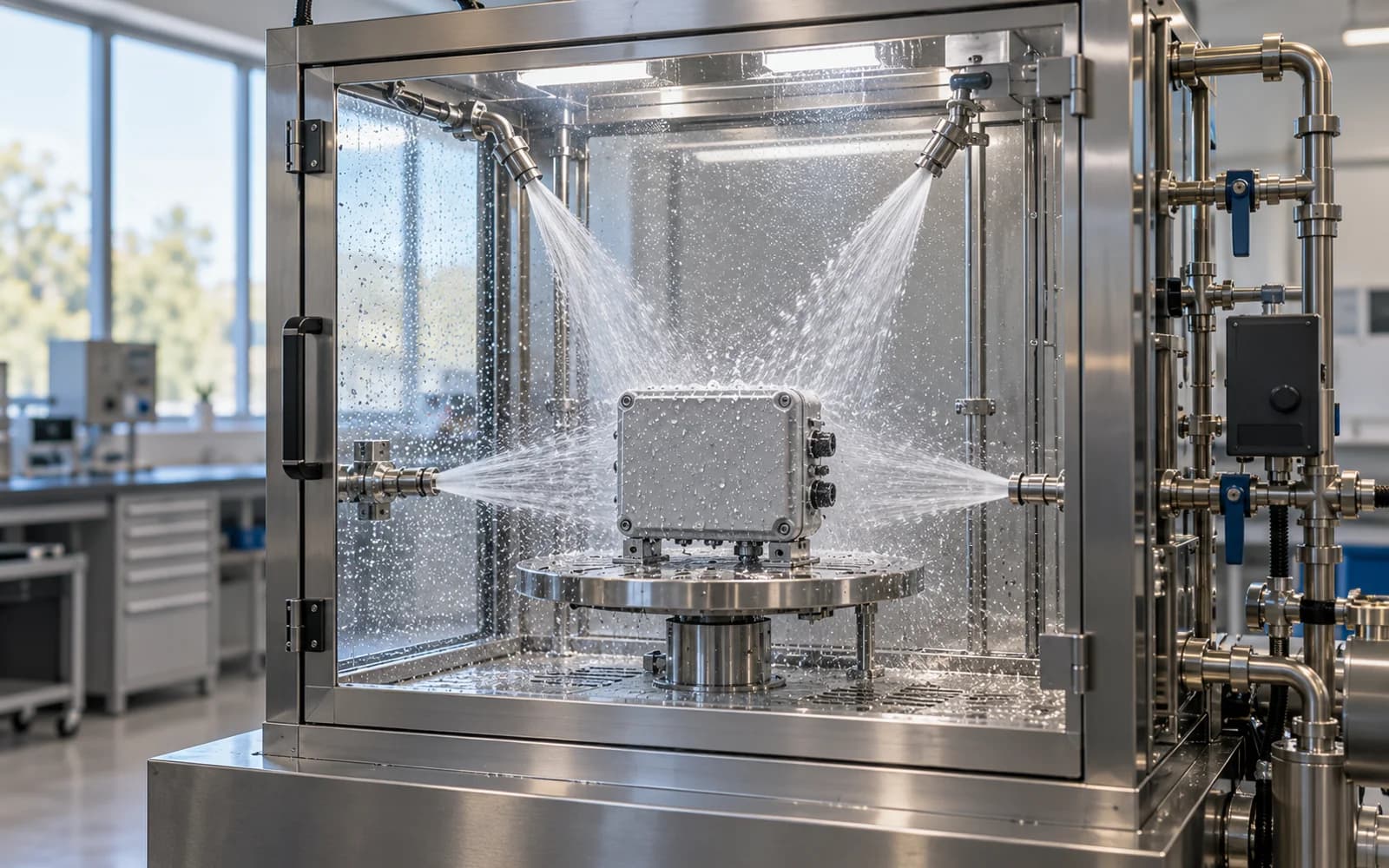
The IP (Ingress Protection) code defined by the IEC has two digits. The first grades protection against solid objects and dust from 0 to 6: 5 means dust-protected and 6 means dust-tight. The second grades protection against liquids from 0 to 9: 4 covers splashing water from any direction, 5 water jets, 6 powerful water jets, 7 temporary immersion, 8 continuous immersion and 9 high-pressure, high-temperature water jets.
An X in place of a digit means that characteristic is not specified or not tested. IPX4, for example, describes protection against water only and makes no claim about dust. IEC 60529 also defines additional letters for the protection of persons against access to hazardous parts. Stating the code and the test condition, rather than a general word such as "waterproof", is a clearer commitment to customers and market surveillance.
IP65 versus IP67: jets and immersion are different conditions
A higher second digit does not always mean broader protection. IPX7 describes temporary immersion at a given depth and duration, while IPX5 and IPX6 describe water jets from different directions. Under IEC 60529 an enclosure rated only 7 or 8 is not considered suitable for water jets; that is shown only by dual coding (for example IP65/IP67), in which case both test conditions must be met.
For an outdoor luminaire exposed to rain and cleaning, jet resistance may matter more; for a sensor that may briefly sit under water, immersion may matter more. Describing the real use keeps you from choosing a rating that is higher and more expensive than needed, or a target that falls short.
What to settle before testing
The IP rating is assessed with the enclosure mounted as in normal use. Cable entries, glands, connectors, vents and seals should be on the sample exactly as they will be sold. For a wall-mounted product, the mounting surface and the tightening torque of the cover also affect the test set-up, and this information should match the instructions for use.
For the dust test it also matters whether a pressure difference builds up inside the enclosure: IEC 60529 places enclosures in categories on this basis, and in some cases the test is run with reduced internal pressure. The standard gives general acceptance conditions; the relevant product standard may add criteria such as electrical safety checks after the test. Identifying early which product standard calls for the IP requirement reduces surprises.
Check before you send samples
- The target IP rating and, if needed, dual coding (for example IP65/IP67) are agreed in writing.
- The real use environment, such as rain, washing, immersion or dust exposure, is described.
- Cable entries, glands, connectors and seals match the production version.
- Mounting orientation, mounting surface and cover tightening instructions travel with the sample.
- The acceptance criteria applied after the test and the relevant product standard are identified.
- The IP code on the label and in the technical documentation matches the tested configuration.
An IP rating is not a market approval on its own; it is assessed as a requirement within the legislation and product standard that apply to the product. List the enclosure and seal differences across the product family separately when you plan the test scope.
Official sources
Sources checked:
- IEC · Ingress Protection (IP) ratings
- IEC 60529 · Degrees of protection provided by enclosures (IP Code)
Scope depends on the product, intended use and target market. This article does not constitute a product conformity decision.
NEXUSTEST
Let's set your IP target around how the product is used
Share your drawings, use environment and target market, and we will prepare the first assessment of the IP rating, samples and test set-up together.
Discuss your project